
From Taiwan to Paris: The Invisible Supply Chain Behind a €99/kg Mango
Why does a single Taiwanese mango sell for €99 per kilogram in Paris? Behind this premium fruit lies a 10,000-kilometer journey shaped by years of regulatory negotiations, strict quarantine requirements, fragile cold-chain logistics, and a carefully crafted luxury-market strategy. From Taiwan's farms to Michelin-starred kitchens in France, every step must work flawlessly to preserve quality and justify its remarkable price. Discover how an ordinary mango became one of Taiwan's most extraordinary exports and what its journey reveals about the invisible power of End-to-End Supply Chain management.
The Taste of Summer Feast @ Taiwan
6/22/2026
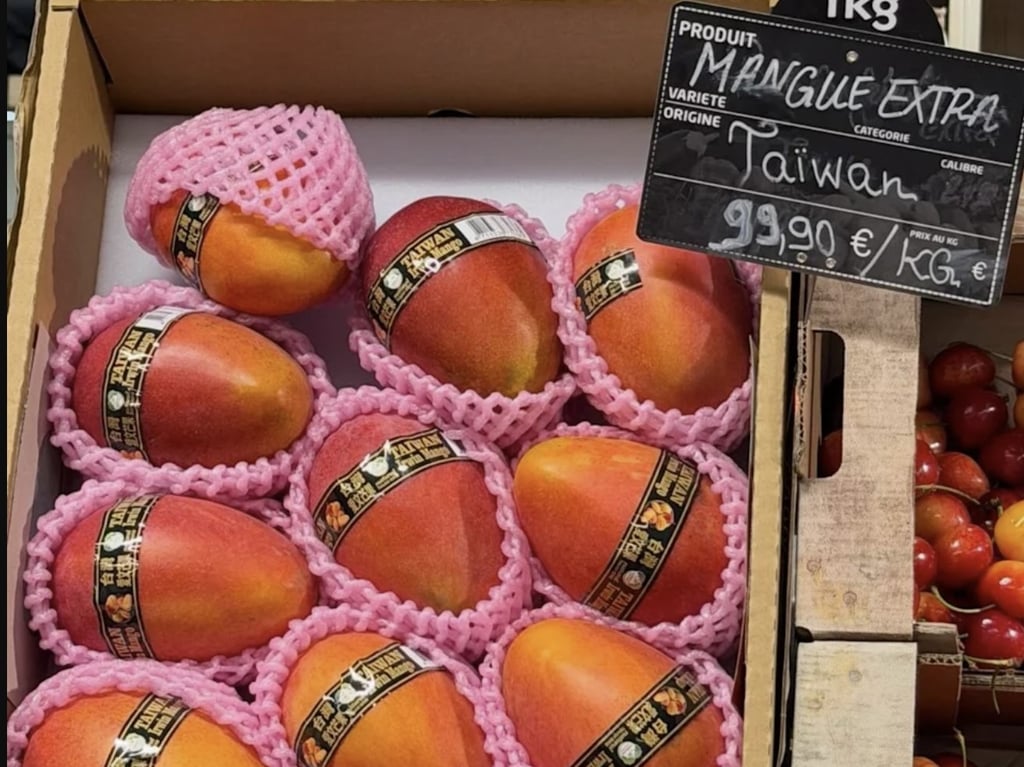
photo credit: Threads @bernice_wang.tw
In June, Taiwanese Irwin mangoes made history by appearing for the first time at Galeries Lafayette, one of Paris' most iconic department stores.
Wrapped in delicate pink foam nets and carrying elegant black-and-gold labels, these mangoes were treated less like fruit and more like luxury goods. At one point, they were even displayed beside a security guard.
Why would a Taiwanese mango sell for €99.9 per kilogram in Paris?
Behind this 10,000-kilometer journey lies a complex story of regulatory negotiations, quarantine requirements, cold-chain logistics, and a carefully designed luxury-market strategy.
This is the story of the invisible Supply Chain behind one of Taiwan's most premium exports.
The First Barrier: Market Access
The journey began in 2019, when the European Union introduced its Plant Health Law, imposing strict import controls on mangoes from regions affected by the Oriental fruit fly, including Taiwan.
Before these mangoes could begin their journey to Paris, a much bigger challenge had to be solved: gaining access to the European market.
How do you eliminate pest risks without damaging the fruit itself while meeting the EU's strict import requirements?
The answer was Vapor Heat Treatment (VHT), a specialized quarantine process that uses carefully controlled heat to eliminate pests while preserving the mango's sweetness, texture, and overall quality.
Finding that balance was no simple task. The treatment must be effective enough to satisfy quarantine requirements, yet gentle enough to avoid compromising the fruit itself.
It took years of research, testing, and collaboration to prove that Taiwan's protocols could meet international standards without sacrificing quality.
The system gradually gained recognition from Japan, South Korea, and the United States. After years of technical validation and regulatory discussions, the European Commission finally approved imports of Taiwanese mangoes in 2025.
The Logistics: The Fragility of the Cold Chain
Once approved for the European market, the mangoes still had to survive a journey of more than 10,000 kilometers from Taiwan to Paris while maintaining perfect freshness and quality.
Unlike manufactured goods, mangoes continue to ripen post-harvest. Any interruption in the cold chain, whether during packing, airport handling, customs clearance, or final delivery, poses a critical risk of damaging the fruit or leading to total shipment rejection.
To minimize transit time and preserve quality, the Taiwanese exporter, Nature House Group, relies on express air freight with a lead time of just three to five days. However, speed comes at a cost. Logistics accounts for nearly half of the product's total cost, and airfreight rates have surged by 50% to 100% amid ongoing geopolitical tensions in the Middle East.
The Strategy: Value Over Volume
Yet none of this would matter without a product worth delivering.
According to French importer Sun 7 Fruits, Taiwanese Irwin mangoes stand out for their exceptional sweetness, dense flesh, and unusually small pit. The result is a fruit with a richer texture, more edible flesh, and an intense flavor profile that sets it apart from many mango varieties commonly available in Europe.
Recognizing this opportunity, Taiwanese exporter Nature House Group deliberately chose not to compete in the mass market. Instead, it partnered with Sun 7 Fruits to position Taiwanese mangoes as a premium culinary product.
The first shipments were distributed through luxury hotels, Michelin-starred restaurants, premium delicatessens, and concept stores, with only limited quantities available to retail consumers. Rather than selling volume, the strategy focused on creating value and exclusivity.
This positioning helped justify the high costs of air freight while reinforcing the image of Taiwanese mangoes as a rare and premium product rather than an everyday fruit.
Yet entering the market is only part of the challenge. Long-term success will depend on helping chefs and consumers understand what makes Taiwanese mangoes unique, from their exceptional sweetness and dense flesh to the years of research, strict quarantine requirements, and complex supply chain behind every mango.
The Next Milestone
Today, Taiwanese mangoes have successfully landed in Paris.
But from an End-to-End Supply Chain perspective, this is only the beginning.
Airfreighting a few tons of mangoes is a successful market-entry strategy. It proves that demand exists and that Taiwanese premium fruit can compete in one of the world's most demanding culinary markets.
The next challenge is how to expand while preserving the exclusivity and quality that make Taiwanese mangoes so valuable in the first place.
Controlled Atmosphere (CA) containers and ocean freight may offer one possible path to lower logistics costs and broader market access. However, whether such a transition can be achieved without compromising product quality or premium positioning remains an open question.
The mango has already made it to Paris. The next milestone is building a supply chain that can stay there.
La cartographie des saveurs Mixingredients
Cinq plats du monde, cuisinés au rythme des saisons du Québec
© 2026 Mixingredients
Une marque de Studio V.K. | A brand of V.K. Studio
Tous droits réservés. | All rights reserved
Un guide pour cuisiner avec une inspiration mondiale et des ingrédients de saison